


"Yamabushitake" and "Bearded Tooth Mushroom"
Table of contents
- Why this matters: the mycelium-on-grain problem
- Active compounds you want: hericenones, erinacines, β-glucans, polysaccharides
- Five criteria for a quality supplement
- Extract vs powder vs capsule vs tincture: bioavailability compared
- Dosage standards: what trials actually used
- Red flags: claims that signal low quality
- How to read a Certificate of Analysis (COA)
- Comparison framework: a rubric you can apply to any product
- Frequently asked questions
- Where to buy a quality EU-made extract
- References
TL;DR
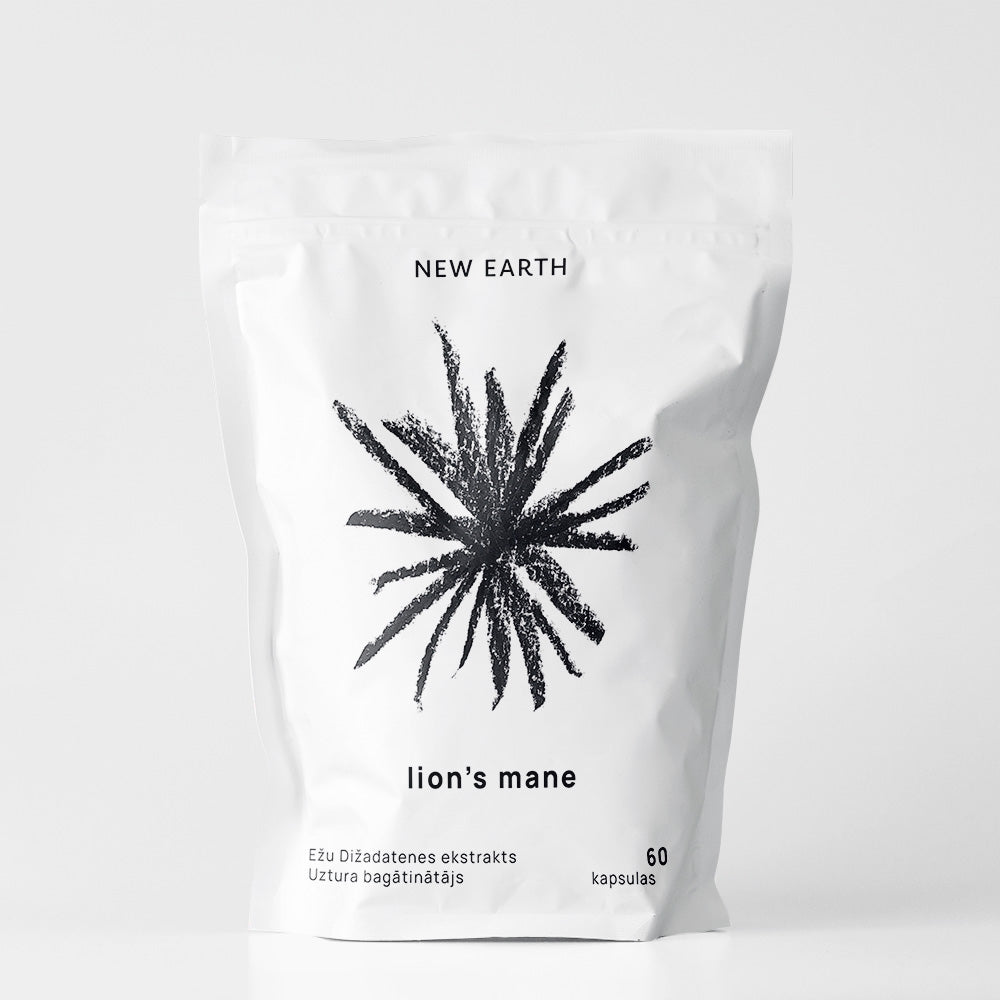
A quality Lion's Mane supplement (Hericium erinaceus) is fruiting-body dual extract with at least 25% beta-glucans on a third-party COA, dual-extracted (water + ethanol) at 10:1 DER. NEW EARTH Lion's Mane: Eurofins Lab-tested 51.2% beta-glucans (hydrolysis-corrected) : the upper end of what is commercially achievable.
Friedman 2015 (J Agric Food Chem) mapped the chemistry of Hericium erinaceus in detail and arrived at one finding the supplement aisle has been slow to honour: hericenones sit in the fruiting body, erinacines sit in the mycelium, and beta-glucans concentrate in the cell walls of the fruiting body during the reproductive stage. Most products on Amazon are not built around that biology. They are built around what is cheap to grow. This guide is for the reader who has already decided Lion's Mane is worth trying - perhaps after reading the Lion's Mane benefits guide : and now wants a concrete way to choose between the forty bottles in the search results.
1. Why this matters: the mycelium-on-grain problem
Roughly seven out of ten Lion's Mane products sold in the major English-speaking online marketplaces are not what a botanist would call Lion's Mane extract — they are mushroom mycelium grown through a grain substrate, with the grain still in the bottle.
The 70% figure comes from industry analyses of supplements listed on Amazon US, with the most-cited 2015 audit by Jeff Chilton (Nammex) reporting that 74% of tested products were primarily mycelium grown on a grain substrate, with the grain still in the bottle. Independent re-analyses since have produced figures in the same range. The exact percentage shifts year to year; the structural problem does not.
Mycelium-on-grain looks like this in production. A sterilised bag of rice or oats is inoculated with Hericium erinaceus mycelium, kept warm for two to three weeks, and then dried and milled — grain and all. The finished powder is sold as "Lion's Mane" because the mycelium is genuine. What the label rarely discloses is that the grain typically makes up 40 to 70% of the final dry weight. That grain shows up on a polysaccharide assay as starch, and starch reads on a total-polysaccharide test the same way beta-glucans do, unless the assay separates them.
The product that produced the cognitive-impairment result in Mori 2009 was not mycelium-on-grain. It was a standardised extract of the fruiting body — the white, tooth-like mushroom Hericium erinaceus produces in its reproductive stage, at the dose of 3000 mg per day. If a buyer's goal is to repeat that protocol at home, the input must look like the input the trial used.
2. Active compounds you want: hericenones, erinacines, β-glucans, polysaccharides
"Most hericenones occur in fruiting bodies, while erinacines are largely confined to mycelia. Both classes induce nerve growth factor (NGF) synthesis, supporting the case for whole-mushroom extracts that capture the chemistry of both growth stages." [1]Lion's Mane carries three compound classes worth paying for, and each class lives in a different part of the mushroom.
Hericenones are aromatic compounds first isolated from the Hericium erinaceus fruiting body in the early 1990s. Hericenones C, D and E induce nerve growth factor (NGF) synthesis in cultured astrocytes — a finding that anchors most of the cognitive-support discussion around Lion's Mane. Friedman 2015 noted that hericenones are largely confined to the fruiting body and not detected at meaningful levels in submerged-culture mycelium.
Erinacines are diterpenoids isolated primarily from the mycelial growth phase. Erinacines A, B and C cross the blood-brain barrier in animal models and induce NGF in vivo at lower doses than hericenones do in vitro. Pure mycelium fermented under controlled conditions can be a legitimate erinacine source. The catch — see section 1 — is that almost no commercial supplement is pure mycelium; mycelium-on-grain is the default, and the grain dilutes the erinacine fraction proportionally.
Beta-glucans are branched polysaccharides locked into the cell walls of the fruiting body. Wasser 2002 (Appl Microbiol Biotechnol) reviewed beta-glucans across more than thirty species of medicinal mushrooms and described their immunomodulatory mechanism via dectin-1 and TLR-2 receptors on macrophages and dendritic cells. Beta-glucans are also fermented in the colon, where they support short-chain-fatty-acid production by the gut microbiome — a prebiotic action with documented impact on inflammatory tone.
Polysaccharides as a category include beta-glucans plus alpha-glucans (starches, glycogen) and a long tail of minor sugars. On a label, "polysaccharides ≥30%" is meaningless without the alpha/beta split. A grain-heavy mycelium product can hit 30% total polysaccharides and contain almost no active beta-glucans. Wasser 2002 is explicit on this — the immunomodulatory action belongs to the (1→3),(1→6)-β-D-glucan fraction, not to total polysaccharide mass.
For a buyer, the practical takeaway is short. A real Lion's Mane supplement should disclose the beta-glucan figure separately. Anything that hides behind total-polysaccharide percentages is hiding for a reason.
3. Five criteria for a quality supplement
Five questions cover the whole rubric. The label and a current COA should answer all five — any one that comes up blank tells you the product isn't a quality supplement, regardless of the marketing.
3.1 Fruiting body, not mycelium-on-grain
The label should say "fruiting body" or "fruiting-body extract" in plain English. Words like "full spectrum", "whole mushroom" or "myceliated rice" are signals for grain content. Fruiting body provides hericenones, the beta-glucan profile, and the cell-wall architecture that survives ethanol extraction. Mycelium-on-grain provides starch, a small fraction of erinacines, and a great deal of cellulose.
3.2 Beta-glucan percentage on the COA (≥25%)
The number that matters is beta-glucan content, separately reported from alpha-glucan, ideally tested by an enzymatic-spectrophotometric assay (the Megazyme mushroom-and-yeast kit is the industry standard). The minimum a serious fruiting-body dual extract should hit is 25%. Premium European extracts reach 30 to 55%. NEW EARTH's most recent Eurofins bioactive panel (analytical report AR-25-EP-058225-02, 24.08.2025; Eurofins Estonia, Tallinn) measured 51.2% beta-glucans hydrolysis-corrected and reported alpha-glucan separately at 24.1% w/w — sitting at the upper end of what is commercially achievable for fruiting-body dual extract.
3.3 Dual-extraction method (water + ethanol)
Beta-glucans are water-soluble; hericenones and erinacines are alcohol-soluble. A water-only extract leaves the aromatic compounds in the marc; an alcohol-only extract leaves the polysaccharides behind. Dual extraction — separate water and ethanol passes, recombined — captures both fractions. Lion's Mane has a documented split between hydrophilic and hydrophobic actives, so dual extraction is the format that matches the chemistry, not a marketing choice.
3.4 Drug-to-extract ratio (DER ≥10:1)
DER is the most under-specified number on the supplement market. A 10:1 DER means ten kilograms of starting raw material produced one kilogram of finished extract. A 4:1 ratio is barely concentrated; a 10:1 to 15:1 ratio matches what the Mori and Saitsu trials used. Khan et al. 2013 (J Complement Integr Med, review) summarised extraction practices across the medicinal-mushroom literature and found DER below 8:1 in mycelium products and 10:1 to 30:1 in fruiting-body dual extracts.
3.5 Third-party lab testing
In-house QC is not a third party. The lab name on the COA should be Eurofins, SGS, Bureau Veritas, Intertek, or a comparably accredited contract laboratory carrying ISO/IEC 17025. The report should reference your specific batch — not a year-old "sample COA". A producer that won't email you the COA for the bottle in your hand is signalling that there isn't one.
4. Extract vs powder vs capsule vs tincture: bioavailability compared
Format matters less than concentration, but it does shape how the dose lands. Four formats cover essentially all of what's on the shelf.
| Format | Typical concentration | Bioavailability | When to use |
|---|---|---|---|
| Dual extract powder (loose) | 25–55% beta-glucans, 10:1 DER | High — immediate dispersion in water | Daily use mixed into coffee, tea or smoothies |
| Capsules of dual extract | Same powder, encapsulated | Equivalent to loose powder | Travel, dose precision, taste avoidance |
| Tincture (alcohol-based) | Variable; usually 1:5 or 1:10 | Fast absorption (sublingual) | Acute use; less practical for steady cognitive protocols |
| Plain dried fruiting-body powder | 1–3% beta-glucans (raw), no concentration | Moderate — cell walls partly intact | Culinary use; not a supplement protocol |
For the cognitive-support use case the Lion's Mane benefits article covers, dual extract powder or capsules are the practical choice. Tinctures fit short, occasional use. Reaching the gram-range daily doses Mori and Saitsu used would mean drinking very large volumes of alcohol — that defeats the point of an extract format.
Plain dried fruiting-body powder is a different animal. As a culinary ingredient, it is excellent — see the Lion's Mane recipe collection for usable preparations. As a supplement protocol it is impractical: matching 3000 mg of 10:1 extract requires roughly 30 g of dried mushroom per day.
5. Dosage standards: what trials actually used
Three trials anchor the dose discussion, each at a different point on the curve. Their numbers, not marketing claims, are what a buyer should reach for.
Mori K et al. 2009 (Phytother Res, n=30, 16 weeks) used 1000 mg of Hericium erinaceus dry-powder extract three times daily — 3000 mg/day total — in adults aged 50 to 80 with mild cognitive impairment. The treatment group improved on the Revised Hasegawa Dementia Scale at weeks 8, 12 and 16; the effect reversed within 4 weeks of cessation. The trial used capsules containing 96% mushroom extract (4% rice bran).
Saitsu Y et al. 2019 (Biomed Res, n=30, 12 weeks) used 3200 mg/day of Hericium erinaceus extract powder in adults aged 50 and over. Cognitive function scores rose at weeks 8 and 12; serum BDNF rose in parallel.
Nagano M et al. 2010 (Biomed Res, n=30, 4 weeks) used 0.5 g of dried fruiting-body powder three times daily — 1500 mg/day — in women presenting with menopause-related anxiety and irritability. The treatment group reported lower Indefinite Complaints Index and Center for Epidemiologic Studies Depression scale scores than placebo. The dose here is lower because the form is whole powder rather than concentrated extract.
| Trial | Form | Daily dose | Duration | Outcome |
|---|---|---|---|---|
| Mori 2009 (n=30) | Dry-powder extract, capsule | 3000 mg (1000 mg × 3) | 16 weeks | Cognitive scale improvement; reversed within 4 weeks of cessation |
| Saitsu 2019 (n=30) | Extract powder | 3200 mg | 12 weeks | Cognitive function + serum BDNF rose |
| Nagano 2010 (n=30) | Dried fruiting-body powder | 1500 mg (0.5 g × 3) | 4 weeks | Lower depression/anxiety scale scores in menopausal women |
A reasonable starting protocol for a quality 10:1 dual extract is 1000 mg twice daily — once with breakfast, once with lunch — sustained for at least 8 weeks before assessing whether the response justifies continuing. Some users add a third 1000 mg dose mid-afternoon to match Mori 2009. Doses above 4 g/day are not supported by the trial literature and have not been formally evaluated for long-term safety.
6. Red flags: claims that signal low quality
A handful of phrases on a Lion's Mane label or product page should make a careful buyer set the bottle down.
- "Mushroom mycelium" without "fruiting body" alongside it. The mushroom in mycelium is real; the rest of the bag is grain. Without fruiting-body content, hericenones are absent and beta-glucans are diluted by starch.
- "Proprietary blend" with no individual ingredient weights. Blends hide both dose and source. If a Lion's Mane label lists "proprietary mushroom matrix 1500 mg" instead of "Hericium erinaceus fruiting-body extract 1000 mg", the buyer cannot match a clinical dose.
- "Polysaccharides ≥30%" with no separate beta-glucan figure. As section 2 covers, this number is satisfied by grain starch and is not an indicator of activity.
- No COA available, or only a "sample COA" not tied to a batch number. The COA is the entire point of a serious supplement; a producer that won't share the current one is signalling the result.
- A retail price under 0.30 EUR per gram of finished extract. Real fruiting-body dual extract costs more than that to manufacture in the EU, before margin. Prices below that point reflect filler.
- "Treats Alzheimer's", "cures dementia", "boosts your IQ" and any disease claim. Beyond being scientifically wrong, these claims are illegal under EU Regulation (EC) 1924/2006 on nutrition and health claims for foods. A producer willing to break that law to sell a supplement is not the producer to trust on what's actually in the bottle.
7. How to read a Certificate of Analysis (COA)
A COA reads like a wall of numbers the first time. It is actually a short checklist. Six checks done in order will tell you whether the document is genuine, current, and showing what it should show.
Step 1 — Lab name and accreditation. Top of the document. Look for an accredited third-party laboratory: Eurofins, SGS, Bureau Veritas, Intertek. The accreditation number — typically ISO/IEC 17025 — should be visible in the report header. "In-house QC" is not third-party. A COA on the producer's own letterhead, without a contract-lab name, fails this check.
Step 2 — Batch number matches the bottle. The batch or lot number on the COA must match the batch printed on the bottle in your hand. A producer who emails you a COA for a different batch is sending you marketing.
Step 3 — Test date is current. The test date should sit within 12 months of your purchase date. Lion's Mane bioactives — hericenones especially — degrade over time. A COA from 2019 attached to a 2026 batch tells you what the product looked like seven years ago, which is not what is in the bottle now.
Step 4 — Beta-glucan line, not the polysaccharide line. The figure that matters is beta-glucans as a percentage of dry weight, ideally measured by an enzymatic-spectrophotometric assay that separates β-glucan from α-glucan (Megazyme's mushroom-and-yeast kit is the industry standard). Premium fruiting-body dual extracts reach 30 to 55%; 25% is a credible minimum floor. "Total polysaccharides ≥30%" without a beta-glucan figure is a fail.
Step 5 — Heavy metals and microbiology pass EU thresholds. Lead, cadmium, mercury and arsenic must sit below EU Commission Regulation (EC) 1881/2006 limits for food supplements. Microbiology — total aerobic count, E. coli, Salmonella, yeasts and moulds — must pass European Pharmacopoeia 5.1.4 thresholds. Any "not tested" or missing line is a fail. Any value over the limit is a fail. Both happen, and both have been published by EU customs intercepts.
Step 6 — DER and extraction method match the label. The COA confirms what's in the powder; the label tells you how concentrated it is. A 10:1 DER fruiting-body dual extract means 10 kg of dried fruiting body went into 1 kg of finished extract. If the label says "extract" but neither a DER nor a solvent appears anywhere, treat the product as ground mushroom powder, not extract.
Our verification
NEW EARTH's most recent Eurofins bioactive panel (analytical report AR-25-EP-058225-02, 24.08.2025; Eurofins Environment Testing Estonia, Tallinn) covers steps 1, 3 and 4 of the checklist directly. The sample (code 337-2023-00047964, sampled 07.08.2025) is identified on the report as "Lion's Mane extract — from a fruiting body". Beta-glucan content tested at 51.2% w/w hydrolysis-corrected (46.9% uncorrected), with alpha-glucan separated and reported at 24.1% w/w — proof the enzymatic-spectrophotometry method distinguished the two fractions instead of merging them under "polysaccharides". Total polyphenols come in at 7,640 mg/kg as gallic-acid equivalent, with the catechine fraction at 6,030 mg/kg and the EGCG-equivalent fraction at 10,230 mg/kg. The polyphenol panel sits within ISO/IEC 17025:2018 accreditation (ACCREDIA 0490L); the glucan panel uses an internal enzymatic-spectrophotometry method that is outside that specific accreditation scope — and the report says so explicitly, which is the kind of honesty a buyer wants on a COA rather than vague "lab-tested" language. Heavy-metals and microbiology panels (steps 5–6) are issued as separate analytical reports against EU Commission Regulation (EC) 1881/2006 and European Pharmacopoeia 5.1.4 thresholds; both are available alongside the bioactive panel. The full set is shared with any customer who emails hello@newearth.health and is referenced from the extraction-method page.
8. Comparison framework: a rubric you can apply to any product
Rather than ranking specific products — which becomes outdated within a month of publication — the more durable tool is a rubric the reader can hold up against any bottle. Score each line zero or one; a quality product scores eight or higher.
| Criterion | Score 0 | Score 1 |
|---|---|---|
| Format named on label | "Mushroom blend", "myceliated", "full spectrum" | "Fruiting-body extract" |
| Beta-glucan figure on label or COA | Missing, or "polysaccharides only" | Beta-glucan ≥25% by dry weight |
| Extraction method | None stated, or water-only | Dual extract (water + ethanol) |
| Drug-to-extract ratio | None stated, or under 8:1 | DER ≥10:1 |
| COA available | None, or generic sample only | Batch-specific, ≤12 months old |
| Issuing laboratory | In-house QC | Accredited third party (ISO/IEC 17025) |
| Heavy metals + microbiology | Not reported, or one missing | All four metals + full micro panel pass |
| Origin transparency | Country not stated | Country and producer named |
| Price per gram of finished extract | Under 0.30 EUR/g | At or above 0.30 EUR/g |
| Health claims | Disease claims, "cures", "treats" | Function claims only, EU-compliant |
Take this rubric with you. It is not specific to NEW EARTH; it works against any Lion's Mane bottle on any shelf in any country. A product that scores ten of ten in the EU has been built to actually deliver what the trial literature describes. A product scoring under five is mostly grain.
9. Frequently asked questions
What beta-glucan percentage should I look for in a Lion's Mane supplement?
Aim for at least 25% beta-glucans by dry weight on the COA, measured by an enzymatic assay that separates beta-glucan from alpha-glucan (Megazyme is the industry standard). Premium fruiting-body dual extracts reach 30 to 55%. Anything labelled "polysaccharides ≥30%" without a separate beta-glucan figure is most likely counting starch from a grain substrate, not the active immunomodulatory beta-glucans Wasser 2002 reviewed.
Is mycelium-based Lion's Mane worth anything?
Pure mycelium grown in liquid fermentation does contain erinacines, the NGF-active compound class Friedman 2015 mapped to the mycelial growth phase. The problem is that almost no commercial product is pure mycelium; the standard format is mycelium-on-grain, where the mushroom mycelium grows through sterilised oats or rice and the entire mass — grain included — is dried, ground and sold as "Lion's Mane". Beta-glucan content of mycelium-on-grain typically falls under 7% by independent analysis, with the remainder being grain starch. Fruiting-body dual extract is the only format that reliably contains both hericenones and erinacines with the beta-glucan profile that COAs can verify.
How do I read a Certificate of Analysis?
Six checks. Lab name is an accredited third party. Batch number on the COA matches the bottle you hold. Test date is within 12 months. Beta-glucan content is reported separately from total polysaccharides. Heavy metals and microbiology pass EU thresholds. The DER and extraction method on the label match the powder analysed. If any of those fail, the product is either old, mislabelled, or wasn't tested for what matters.
Does Lion's Mane extract work better than the raw mushroom?
For specific bioactive doses — yes. Raw fruiting body contains roughly 1 to 3% beta-glucans by dry weight; a 10:1 dual extract concentrates that to 25 to 50%. Mori 2009 used 1000 mg of standardised extract three times daily for the cognitive RCT result; matching that dose with raw mushroom would mean 60 to 100 g of dried fruiting body per day. For everyday culinary use the raw mushroom is excellent food. For a measured cognitive or nerve-support protocol, a standardised extract is the practical format.
How much Lion's Mane should I take daily?
The clinical range that produced positive cognitive results sits between 1000 and 3200 mg of standardised fruiting-body extract per day. Mori 2009 used 3000 mg/day split into three doses for 16 weeks; Saitsu 2019 used 3200 mg/day for 12 weeks; Nagano 2010 saw mood effects at 1500 mg/day of powder over 4 weeks. A reasonable starting protocol is 1000 mg twice daily with breakfast and lunch, sustained for at least 8 weeks before reassessing.
Why are some Lion's Mane supplements so cheap?
Because they are not what the label suggests. Producing a real fruiting-body dual extract costs roughly 0.80 to 2.00 EUR per gram at quality wholesale; a 60-capsule bottle of genuine 500 mg dual extract sits around 30 to 45 EUR retail in the EU. A 60-capsule bottle priced under 15 EUR is almost always mycelium-on-grain — the grain is the cost-saver. The label is technically allowed to say "Lion's Mane" because mycelium is part of the organism; what's missing is a beta-glucan figure, a DER, and a third-party COA.
10. Where to buy a quality EU-made extract
Lion's Mane that meets every line on the rubric in section 8 exists in the EU, made and tested under conditions the COAs can document end-to-end. NEW EARTH's Lion's Mane is fruiting-body dual extract (water + ethanol), 10:1 DER, with the most recent Eurofins bioactive panel measuring 51.2% beta-glucans hydrolysis-corrected, alpha-glucan separately reported at 24.1%, and 7,640 mg/kg total polyphenols as gallic-acid equivalent (Eurofins Estonia analytical report AR-25-EP-058225-02, 24.08.2025; sample 337-2023-00047964, from a fruiting body). The polyphenol panel sits within ISO/IEC 17025:2018 accreditation; the glucan panel uses an internal enzymatic-spectrophotometry method outside that scope, with the report stating so explicitly. Production happens in Latvia (New Earth SIA, Riga) under EU HACCP and Novel Food framework; heavy-metals and microbiology panels are issued as separate analytical reports against EU Commission Regulation (EC) 1881/2006 and European Pharmacopoeia 5.1.4 thresholds. The full set of reports is shared per request, tied to the sample code on the bottle.
For readers building a broader functional-mushroom routine, the Mushroom Essentials Complex combines Lion's Mane with Reishi, Chaga and Cordyceps at lower individual doses — useful as a daily baseline, with the standalone Lion's Mane extract reserved for the focused cognitive protocol.
Whether you are matching Mori 2009's protocol, replacing a mycelium-on-grain product, or trying Lion's Mane for the first time — the input matters more than the protocol. A fruiting-body dual extract with a current COA is what the trials used.
11. References
[1] Friedman M. Chemistry, Nutrition, and Health-Promoting Properties of Hericium erinaceus (Lion's Mane) Mushroom Fruiting Bodies and Mycelia and Their Bioactive Compounds. Journal of Agricultural and Food Chemistry. 2015;63(32):7108–7123. PMID 26244378
[2] Mori K, Inatomi S, Ouchi K, Azumi Y, Tuchida T. Improving effects of the mushroom Yamabushitake (Hericium erinaceus) on mild cognitive impairment: a double-blind placebo-controlled clinical trial. Phytotherapy Research. 2009;23(3):367–372. PMID 18844328
[3] Wasser SP. Medicinal mushrooms as a source of antitumor and immunomodulating polysaccharides. Applied Microbiology and Biotechnology. 2002;60(3):258–274. PMID 12436306
[4] Nagano M, Shimizu K, Kondo R, Hayashi C, Sato D, Kitagawa K, Ohnuki K. Reduction of depression and anxiety by 4 weeks Hericium erinaceus intake. Biomedical Research. 2010;31(4):231–237. PMID 20834180
[5] Saitsu Y, Nishide A, Kikushima K, Shimizu K, Ohnuki K. Improvement of cognitive functions by oral intake of Hericium erinaceus. Biomedical Research. 2019;40(4):125–131. PMID 31413233
[6] Khan MA, Tania M, Liu R, Rahman MM. Hericium erinaceus: an edible mushroom with medicinal values. Journal of Complementary and Integrative Medicine. 2013;10(1). PMID 23735479
[7] EFSA Panel on Dietetic Products, Nutrition and Allergies. Scientific Opinion on the substantiation of health claims related to beta-glucans from oats and barley and maintenance of normal blood LDL-cholesterol concentrations. EFSA Journal. 2011;9(6):2207. EFSA
[8] European Commission. Commission Regulation (EC) No 1881/2006 setting maximum levels for certain contaminants in foodstuffs. Official Journal of the European Union. 2006. EUR-Lex
Lab reports:
Eurofins Environment Testing Estonia (Tallinn), Analytical Report AR-25-EP-058225-02 (24.08.2025), bioactive panel on sample 337-2023-00047964 ("Lion's Mane extract — from a fruiting body", sampled 07.08.2025). Beta-glucan (hydrolysis-corrected) 51.2% w/w; beta-glucan (uncorrected) 46.9% w/w; alpha-glucan 24.1% w/w; polyphenols 7,640 mg/kg as gallic-acid equivalent (catechine 6,030 mg/kg; tannic-acid 8,970 mg/kg; epicatechine 4,940 mg/kg; EGCG-equivalent 10,230 mg/kg). Glucans by internal enzymatic-spectrophotometry method (HEC4J, not within accreditation scope on this report); polyphenols by internal spectrophotometry (ID849) under ISO/IEC 17025:2018 accreditation (ACCREDIA 0490L). Heavy-metals and microbiology panels are issued under separate Eurofins analytical reports per EU Commission Regulation (EC) 1881/2006 and European Pharmacopoeia 5.1.4 thresholds; available with the bioactive panel on request.
The information in this article is intended for educational purposes and does not replace consultation with a qualified healthcare professional. Functional mushrooms are food supplements, not medicines, and are not intended to diagnose, treat, cure or prevent any disease. Consult a doctor before using supplements during pregnancy, breastfeeding, chronic illness or alongside prescription medication.


