


From fruiting body to fork - seven tested recipes
Table of contents
- What you can do with fresh Lion's Mane
- Recipe 1: Lion's Mane "crab cakes"
- Recipe 2: Pan-seared Lion's Mane "steak"
- Recipe 3: Lion's Mane and mushroom broth
- Recipe 4: Lion's Mane risotto
- Recipe 5: Lion's Mane pâté
- Recipe 6: Lion's Mane tea
- Recipe 7: Lion's Mane coffee blend
- Fresh vs extract - when to use which
- Cooking tips and common mistakes
- Frequently asked questions
- Where to get fresh and extract in the EU

TL;DR
Lion's Mane (Hericium erinaceus) shreds into fibres that taste startlingly close to crab - sweet, briny, slightly nutty. This page collects 7 tested recipes for the fresh fruiting body, from crab-style cakes to a 22-minute decocted tea, and ends with when a 10:1 dual extract (about 1 g per cup) is the right format instead.
What you can do with fresh Lion's Mane
Cooked Lion's Mane has the long fibres, sweet briny flavour and springy bite of crab meat. Every recipe on this page begins with the same first step: drive off the water.
Lion's Mane fruiting body cooked in a hot pan for 8 minutes tastes uncannily of crab. Sweet, briny, slightly nutty. The fibres pull apart in long shreds rather than crumbling, the flavour reads mineral and oceanic instead of earthy and forest-floor, and the texture, once the water has been driven off, has the springy bite of cooked shellfish. The first time most cooks meet this mushroom they assume the comparison is marketing. By the second batch they stop assuming.
The taste profile breaks into three notes. The dominant one is sweetness - a mild, almost shellfish-like sweetness that comes from the free amino acid composition of Hericium erinaceus (the fruiting body is unusually high in alanine, glycine and threonine, the same sweet amino acids that drive the flavour of cooked shellfish, as Friedman 2015 (J Agric Food Chem) documented in his nutrition review). The second is umami - modest but real, from glutamate and 5'-nucleotides. The third is a faint mineral note, distinctively oceanic, that closes the resemblance.
Texture is where the cooking begins. Raw Lion's Mane is about 90% water by weight. Driving off that water is the single decision that separates a soggy disappointment from a properly browned plate. Every recipe on this page begins with the same step in different language: dry-toast, press, sear, simmer uncovered. Treat the mushroom as a wet sponge that needs squeezing.
Recipe 1: Lion's Mane "crab cakes"
This is the most-searched Lion's Mane recipe on the English-speaking internet, and it earns the position. Shred the fruiting body, drive off the water, bind with a flax egg and panko, pan-fry into golden patties. Even seafood-eaters who taste them blind ask which fishmonger you used.

Lion's Mane "crab cakes"
Shredded fresh Lion's Mane bound with flax egg and panko, pan-fried into golden patties that taste startlingly close to real crab cakes.
Ingredients
- 250 g fresh Lion's Mane fruiting body
- 1 tbsp ground flaxseed mixed with 3 tbsp water (flax egg)
- 60 g panko breadcrumbs (gluten-free if needed)
- 2 spring onions, finely chopped
- 1 tbsp Dijon mustard
- 1 tsp Old Bay seasoning (or 1/2 tsp smoked paprika + 1/2 tsp celery salt)
- 1 tbsp lemon juice
- 2 tbsp neutral oil for frying
- Salt and black pepper to taste
Instructions
- Tear the fresh Lion's Mane into long shreds with your fingers, mimicking the texture of pulled crab meat. Do not chop with a knife - torn fibres hold the bind better.
- Heat a dry skillet over medium and toast the shreds for 5 minutes, stirring, until they release their water and the pan is dry. This is the single most important step - wet shreds make soggy cakes.
- Whisk 1 tbsp ground flaxseed with 3 tbsp water and let stand 5 minutes until gelled.
- In a bowl, combine cooled mushroom shreds, flax egg, panko, spring onions, Dijon, Old Bay, lemon juice, salt and pepper. Form into 4 patties about 2 cm thick.
- Heat 2 tbsp neutral oil in a skillet over medium-high. Fry the cakes 3 minutes per side until deep golden and crisp.
- Serve hot with lemon wedges and a vegan tartar sauce (mayo, capers, dill, lemon).
Notes: The shreds shrink by about a third in step 2 - start with 250 g and you will end up with around 170 g of cooked fibre, which is the right yield for 4 patties. If the mix feels too wet to form, add panko a tablespoon at a time.
Recipe 2: Pan-seared Lion's Mane "steak"
A whole fruiting body, pressed and seared in butter with thyme until the outside is bronzed and the inside stays tender. Eight minutes from raw to plate, and you will use it once a week from then on. This is the recipe that converts skeptics - fewer ingredients than fingers on one hand.
Pan-seared Lion's Mane "steak"
A whole fruiting body pressed and seared in butter with thyme until the outside is bronzed and crisp and the inside stays tender - eight minutes, almost no ingredients.
Ingredients
- 1 large Lion's Mane fruiting body, about 200 g
- 30 g unsalted butter (or 2 tbsp olive oil for vegan)
- 1 garlic clove, smashed
- 2 sprigs fresh thyme
- Flaky sea salt
- Cracked black pepper
Instructions
- Slice the fruiting body horizontally into 2 cm thick "steaks". Aim for 2–3 slabs from a 200 g cluster.
- Lay the slices on a plate, cover with another plate and weight with a heavy pan or two cans for 5 minutes. Pressing collapses the spongy interior so the heat reaches the centre.
- Pat slices dry, season generously with salt. Heat a heavy skillet over medium-high until a drop of water dances and evaporates.
- Add butter, swirl, then place the slices in the pan without crowding. Sear undisturbed for 4 minutes until a deep golden crust forms.
- Flip and sear the second side 3 minutes. In the last minute add garlic and thyme, tilt the pan and baste the steaks with the foaming butter.
- Rest 2 minutes on a warm plate. Finish with cracked pepper and an extra pinch of flaky salt.
Notes: The pressing step is doing real work - without it, the centre of a 2 cm steak stays raw while the outside burns. If you have a panini press, two minutes under unheated weight is enough.
Recipe 3: Lion's Mane and mushroom broth
A clear, savoury broth built on Lion's Mane, dried shiitake and kombu. Drink it from a mug as a cold-weather sipping broth, or use it as the base for ramen, risotto and braising liquid. Keeps a week refrigerated; freezes in jars indefinitely.

Lion's Mane and mushroom broth
A clear, savoury broth built on Lion's Mane, dried shiitake and kombu - a sipping broth on its own and the base for ramen or risotto.
Ingredients
- 100 g fresh Lion's Mane, torn
- 50 g dried shiitake (or 30 g dried porcini)
- 1 carrot, roughly chopped
- 1 celery stalk, roughly chopped
- 1 onion, halved
- 2 garlic cloves, smashed
- 1 piece kombu, about 10 cm
- 2 tbsp soy sauce or tamari
- 2 L cold water
- Salt to taste
Instructions
- Place all ingredients except the soy sauce and salt into a large pot. Cover with 2 L of cold water - starting cold extracts more flavour from the kombu and dried mushrooms than starting hot.
- Set the pot over medium heat and bring to a bare simmer. Do not boil - boiling makes the kombu bitter. Skim any foam that rises.
- Simmer uncovered for 45 minutes. The broth will reduce by about a third and turn deep amber.
- Strain through a fine sieve into a clean pot, pressing the solids gently to extract the last of the liquid.
- Stir in soy sauce, taste, adjust salt. Serve hot in mugs as a sipping broth, or use as a base for ramen, risotto or sauces.
Notes: Keep the pulled-out mushroom solids - chop them and fold into a stir-fry the next day. Nothing wasted.
Recipe 4: Lion's Mane risotto
Creamy arborio risotto finished with seared Lion's Mane shreds, white wine, Parmesan and lemon zest. The mushroom is the headline, but the rice technique is what makes it weeknight food rather than restaurant food - 30 minutes of stirring while you listen to something good.

Lion's Mane risotto
Creamy arborio risotto finished with seared Lion's Mane shreds, white wine, Parmesan and lemon zest - comfort food with a forager's edge.
Ingredients
- 200 g fresh Lion's Mane, torn into bite-sized shreds
- 250 g arborio rice
- 1 L hot vegetable or mushroom broth (Recipe 3 works perfectly)
- 150 ml dry white wine
- 1 shallot, finely chopped
- 2 garlic cloves, minced
- 30 g unsalted butter
- 50 g grated Parmesan (or vegan alternative)
- 2 tbsp olive oil
- Zest of 1 lemon
- Salt and black pepper to taste
Instructions
- Heat 1 tbsp olive oil in a wide pan over medium-high. Sear the Lion's Mane shreds 5 minutes, undisturbed, until golden. Lift onto a plate and reserve.
- In the same pan, lower heat to medium. Add remaining olive oil, shallot and garlic. Cook 3 minutes until soft and translucent - do not brown.
- Add the arborio and stir 2 minutes until the grains are coated and translucent at the edges.
- Pour in the white wine and stir constantly until almost fully evaporated.
- Add hot broth one ladle at a time, stirring often, waiting until each addition is absorbed before adding the next. After about 16–18 minutes the rice should be al dente - tender with a slight bite.
- Stir the seared Lion's Mane back into the rice. Off the heat, beat in butter and Parmesan to mantecare - the risotto should be loose enough to flow gently across a tilted plate.
- Plate, finish with lemon zest, cracked pepper and an extra pinch of flaky salt.
Notes: If the broth runs out before the rice is done, top up with hot water - never cold, which arrests cooking.
Recipe 5: Lion's Mane pâté
A silky umami spread of caramelised Lion's Mane, soaked cashews, garlic and thyme. On crusty sourdough with a glass of red, it stands beside any duck-liver pâté you have ever served. Keeps 5 days refrigerated.

Lion's Mane pâté (plant-based)
A silky umami spread of caramelised Lion's Mane, soaked cashews, garlic and thyme - better than the duck-liver original on toast.
Ingredients
- 200 g fresh Lion's Mane, roughly torn
- 1 medium onion, diced
- 2 garlic cloves, minced
- 100 g raw cashews, soaked in cold water for 4 hours and drained
- 2 tbsp olive oil
- 1 tbsp soy sauce or tamari
- 1 tbsp lemon juice
- 1 tsp fresh thyme leaves (or 1/2 tsp dried)
- Salt and black pepper to taste
Instructions
- Heat olive oil in a skillet over medium. Cook the onion 5 minutes until soft and translucent.
- Add the Lion's Mane and cook 10 minutes, stirring occasionally, until the water has fully evaporated and the edges are crisp and bronzed. This is where the flavour comes from - do not rush it.
- Stir in garlic, soy sauce and thyme. Cook 2 minutes more, then take off the heat and let cool 5 minutes.
- Transfer the mushroom mixture to a food processor with the soaked cashews and lemon juice. Blend, scraping down the sides, until completely smooth - about 2 minutes.
- Season with salt and pepper. Pack into a small jar, smooth the top and chill at least 1 hour before serving on toast or crackers.
Notes: A topping of olive oil poured over the surface, sealed flush against the pâté, will keep it fresher for longer in the fridge.
Recipe 6: Lion's Mane tea
The oldest way to take Lion's Mane. A simple decoction of the dried fruiting body simmered for 20 minutes - earthy, savoury, lightly sweet, and warming. Wasser 2002 (Appl Microbiol Biotechnol) noted that the (1→3),(1→6)-β-D-glucan fraction responsible for the immunomodulatory effect of medicinal mushrooms is water-soluble - which is what a 20-minute simmer extracts.

Lion's Mane tea
A simple decoction of dried fruiting body simmered for 20 minutes - earthy, savoury, lightly sweet, the most ancient way to take Lion's Mane.
Ingredients
- 5 g dried Lion's Mane (or 30 g fresh, sliced)
- 500 ml filtered water
- Optional: 1 thin slice fresh ginger
- Optional: 1 tsp honey
- Optional: 1 squeeze of lemon
Instructions
- Combine the water and dried mushroom in a small saucepan. Bring to a gentle simmer over medium heat - never a rolling boil.
- Cover and simmer for 20 minutes. The water will turn light amber and smell faintly of toasted bread.
- Strain into a mug. Add ginger, honey or lemon to taste.
Notes: A beautiful traditional preparation, and it carries water-soluble beta-glucans across well. For a measured cognitive dose closer to the trial literature, the next recipe - and the extract pivot below - is the more concentrated route.
Recipe 7: Lion's Mane coffee blend
The everyday format. One gram of fruiting-body dual extract stirred into your morning coffee - no taste shift, no routine change, a measurable serving of the same standardised material the trial literature uses. Equivalent of the tea above in roughly a tenth of the volume.

Lion's Mane coffee blend
A morning coffee with 1 g of fruiting-body extract dissolved in - the everyday way to take Lion's Mane at a measurable cognitive dose without changing your routine.
Ingredients
- 1 tsp (1 g) Lion's Mane fruiting-body dual-extract powder
- 1 cup (240 ml) freshly brewed coffee or single espresso topped up with hot water
- Optional: 60 ml oat milk, frothed
- Optional: pinch of cinnamon
- Optional: 1 tsp maple syrup
Instructions
- Brew your usual coffee - drip, French press or espresso. Strength is up to you.
- Add 1 g of Lion's Mane dual-extract powder directly into the hot coffee and stir until fully dissolved. The powder is water-soluble so it disperses without lumps.
- Top with frothed oat milk and a pinch of cinnamon if you like. Sweeten with maple syrup to taste.
Notes: This recipe uses extract, not fresh mushroom - fresh Lion's Mane does not dissolve in liquid. That is exactly the bridge the next section is about.
Fresh vs extract - when to use which
Cooked fresh Lion's Mane is excellent food and a genuine source of beta-glucans. A 10:1 dual extract is the format that maps onto the trial-literature dose. The two formats serve different jobs.
Cooked fresh Lion's Mane is excellent food and a genuine source of beta-glucans, sweet amino acids and fibre. It is not a substitute for a standardised extract, and a standardised extract is not a substitute for the food. The two formats serve different jobs, and the difference is concentration.
A quality fruiting-body dual extract concentrates the bioactive load. Raw fruiting body sits at roughly 1–3% beta-glucans by dry weight; a 10:1 dual extract concentrates that to 25–50% and pulls hericenones out of the cell walls into a soluble form (Friedman 2015). When Mori 2009 (Phytother Res, n=30, 16 weeks) reported cognitive improvement in mild cognitive impairment, the protocol used 3000 mg of standardised extract daily - matching that intake with fresh mushroom would mean roughly 60–100 g of dried fruiting body per day. The food is wonderful; the protocol is the supplement. For deeper detail on what to look for, see the Lion's Mane buyer's guide and the full benefits review.
The practical decision tree is simple. Cook fresh when the goal is dinner, sensory pleasure, fibre, and a steady weekly serving of beta-glucans on a real plate. Use extract when the goal is a measurable daily cognitive or nerve-support protocol you can replicate over weeks. Many readers do both - Friday-night seared steaks, Monday-morning coffee with 1 g of dual extract.
Cooking tips and common mistakes
Six small adjustments separate the first attempt from the version you cook for guests.
Tear, do not chop. Lion's Mane has a long-fibre structure that wants to pull apart with the grain. A chef's knife slices across the fibres and leaves a mushy texture; fingers pull along them and produce the shred. Spend the extra 30 seconds.
Drive off the water. Whether by dry-toasting, pressing or searing without crowding the pan, the first move is always dehydration. A wet mushroom steams; a dry mushroom browns. Browning is where the flavour comes from. If your kitchen smells of mushroom but the pan is producing liquid, the heat is too low or the pan is too crowded.
Salt later. Salt added at the start of cooking pulls water out fast and stalls the browning step. Salt the mushroom only after the water has evaporated and the surface has begun to colour.
Use a heavy pan. Cast iron or a thick stainless skillet holds the temperature when the cool mushroom hits it. A thin nonstick skillet drops 50 °C the moment the food lands and you spend the rest of the cook waiting for the pan to recover.
Do not wash, brush. Fresh Lion's Mane absorbs water like a sponge. A quick brush with a soft pastry brush or a damp cloth is enough; never rinse under the tap unless you intend to dehydrate before cooking.
Fat is your friend. Both butter and olive oil work; butter gives the seafood-adjacent crust that makes the crab-cake comparison hold, olive oil gives a cleaner, more vegetal note. Pick to match the dish.
Frequently asked questions
What does Lion's Mane taste like?
Cooked Lion's Mane tastes startlingly close to crab or lobster meat - sweet, briny and slightly nutty. The texture is the giveaway: torn into shreds and seared, the fruiting body splits into long fibres that pull apart exactly like cooked crab. Raw, it is mild, vegetal and slightly chalky, which is why nearly every recipe begins with dry-toasting or searing to drive off water and concentrate flavour.
Can I eat Lion's Mane raw?
Technically yes - Hericium erinaceus is non-toxic raw - but you should not. Raw the texture is spongy and bitter, and like all wild mushrooms the cell walls are hard to digest until heat breaks them down. Even a 5-minute dry sauté transforms it. Cook every recipe; eat raw only as a curiosity tasting.
How do I store fresh Lion's Mane?
Store fresh Lion's Mane unwashed in a paper bag inside the fridge crisper drawer for up to 7 days. Do not seal in plastic - it will sweat and spoil within 48 hours. To extend longer, slice thickly and dehydrate at 40 °C for 8 hours, or freeze raw shreds in a single layer on a tray then transfer to a bag (frozen shreds go straight into the pan, no thawing).
Can I substitute Lion's Mane extract for cooking?
Not for the seven savoury recipes here - extract is a concentrated powder, not a textured protein, so it cannot stand in for the fresh fruiting body in a crab cake or a steak. It works only in liquid recipes (tea, coffee, broth, smoothies, sauces) where 1 g of dual-extract powder dissolves into a beverage and contributes flavour and bioactives without bulk.
Are Lion's Mane recipes gluten-free?
Lion's Mane itself is naturally gluten-free. Of the seven recipes on this page, the broth, pâté, tea and coffee are gluten-free as written. The crab cakes need gluten-free panko and a wheat-free Old Bay (most are fine but check the label). The steak is gluten-free if served plain. The risotto uses arborio rice and is gluten-free, but check that any vegetable broth and Parmesan-style cheese are too.
Where do I buy fresh Lion's Mane in the EU?
Fresh Lion's Mane is sold seasonally (autumn into early winter) by specialty mushroom growers at farmers' markets and at organic grocers in most EU capitals. Year-round availability is climbing as indoor cultivation expands - look for HACCP-certified suppliers selling under the name Hericium erinaceus, Lion's Mane, or in some markets pom pom mushroom. If your local supply is unreliable, a home cultivation kit produces 200–400 g per flush and is the most consistent source.
Where to get fresh and extract in the EU
Fresh Lion's Mane is increasingly available across the EU as indoor cultivation expands. The most reliable seasonal channels are Saturday-morning farmers' markets in major cities (Riga's Centrāltirgus, Berlin's Markthalle Neun, Paris's Marché des Enfants Rouges all have regular specialty-mushroom stalls in autumn), independent organic grocers stocking under the names "Lion's Mane", "Hericium erinaceus", or "pom pom mushroom", and direct-from-grower box schemes that ship next-day across the Schengen area. A home cultivation kit is the most consistent supply if your local market is patchy - one block produces 200–400 g across two flushes over six weeks.
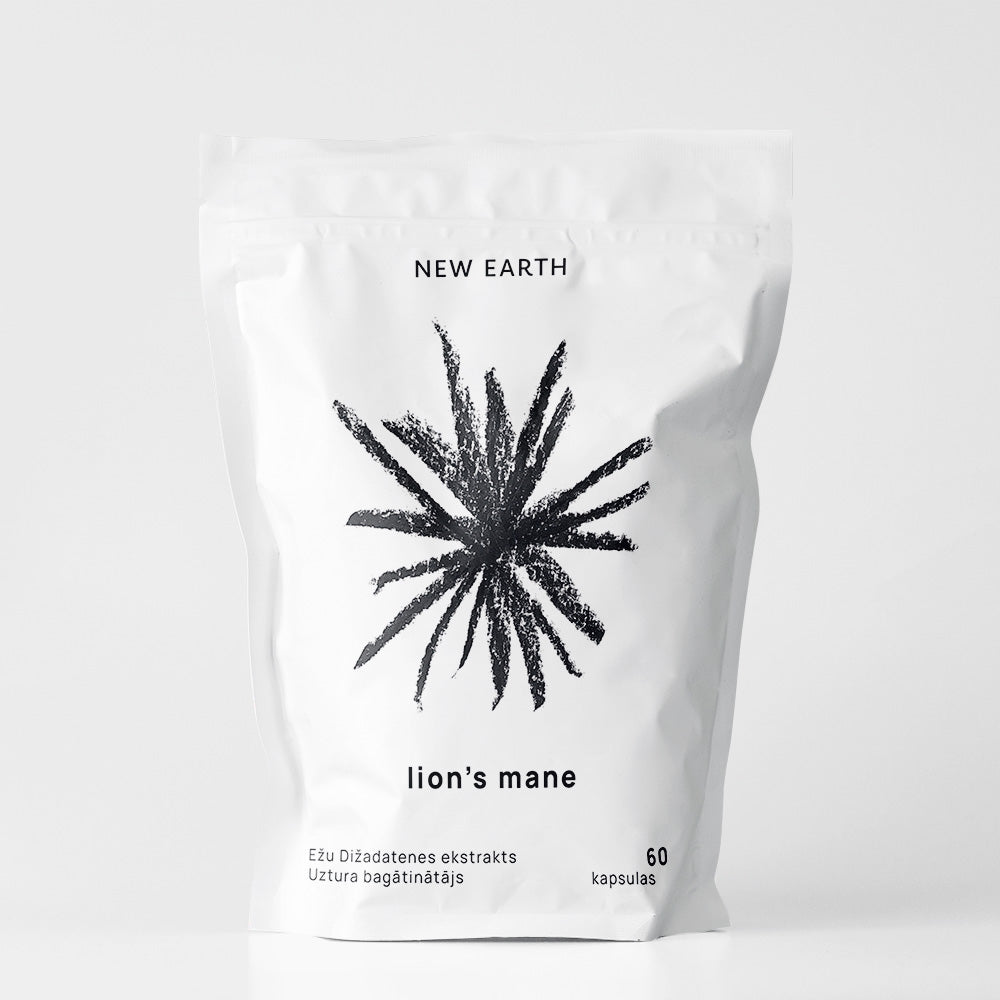
For the extract - the format that maps onto the trial-literature dose, dissolves into Recipe 7 in seconds and travels in a luggage pocket - the New Earth Lion's Mane fruiting-body dual extract is made and tested in Latvia under EU food-supplement regulation. The most recent Eurofins certificate of analysis (report AR-25-EP-058225-02, 24.08.2025) measured 51.2% beta-glucans hydrolysis-corrected, with the heavy-metals and microbiology panels passing European Pharmacopoeia thresholds. The COA is shared on request and tied to the batch number printed on the bottle.
Whether you are searing your first "steak" on a Tuesday night, tasting the sweet amino acids that drive the crab comparison for the first time, or stirring 1 g of extract into a Wednesday-morning coffee - Lion's Mane crosses the line between food and supplement more cleanly than any other mushroom on a European shelf.
References
[1] Friedman M. Chemistry, Nutrition, and Health-Promoting Properties of Hericium erinaceus (Lion's Mane) Mushroom Fruiting Bodies and Mycelia and Their Bioactive Compounds. Journal of Agricultural and Food Chemistry. 2015;63(32):7108–7123. PMID 26244378
[2] Wasser SP. Medicinal mushrooms as a source of antitumor and immunomodulating polysaccharides. Applied Microbiology and Biotechnology. 2002;60(3):258–274. PMID 12436306
[3] Mori K, Inatomi S, Ouchi K, Azumi Y, Tuchida T. Improving effects of the mushroom Yamabushitake (Hericium erinaceus) on mild cognitive impairment: a double-blind placebo-controlled clinical trial. Phytotherapy Research. 2009;23(3):367–372. PMID 18844328
[4] European Commission. Commission Regulation (EC) No 1881/2006 setting maximum levels for certain contaminants in foodstuffs. Official Journal of the European Union. 2006. EUR-Lex
The information in this article is intended for educational purposes and does not replace consultation with a qualified healthcare professional. Functional mushrooms are food supplements, not medicines, and are not intended to diagnose, treat, cure or prevent any disease. Consult a doctor before using supplements during pregnancy, breastfeeding, chronic illness or alongside prescription medication.


